
How We Teach
How Our Curriculum Is Implemented in the Classroom
Our curriculum is carefully designed and implemented over time, following the principles of Curriculum for Wales. We ensure that learning is well-planned, purposeful and developmentally appropriate, supporting all learners to make progress in relation to the statutory Statements of What Matters.
To support high-quality teaching, every unit includes detailed planning and guidance written by subject specialists. These documents strengthen teachers' subject knowledge, provide clarity on progression and reduce workload. This allows teachers to focus more fully on how learning is brought to life in the classroom, ensuring that all pupils engage meaningfully and successfully with the curriculum.
Connecting to Prior Learning
In line with Curriculum for Wales' emphasis on purposeful progression, each lesson begins with a prior learning review. This supports learners to:
- Retrieve knowledge previously taught
- Strengthen long-term memory
- Make connections between new and existing learning
This approach reflects the curriculum's focus on building rich, connected knowledge over time.
Vocabulary-Rich Learning
Curriculum for Wales highlights the importance of communication, language and literacy across all Areas of Learning and Experience (AoLEs). To support this, we place a strong emphasis on explicit vocabulary instruction.
In each lesson, children:
- Are introduced to key vocabulary
- Orally rehearse new words
- Explore meaning and etymology
- Encounter vocabulary in context
- Apply new words in speaking and writing
This supports learners to develop confidence, accuracy and fluency in their communication skills.
Research-Informed Pedagogy
Our teaching always draws upon proven researched based pedagogy, in particular Rosenshine's Principles of Instruction, which complement Curriculum for Wales' expectations for effective pedagogy. Teachers ensure that new learning is:
- Presented in small, manageable steps
- Clearly explained and modelled
- Reinforced through guided and independent practice; 'I do, We do, You do'
- Scaffolds and Worked Examples
- Discussed and verbalised through structured talk
This approach enables all children to access ambitious content, develop secure understanding and make sustained progress.
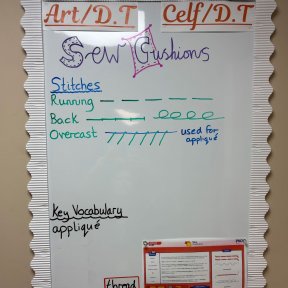
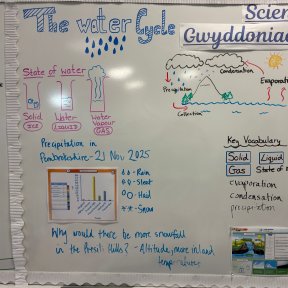
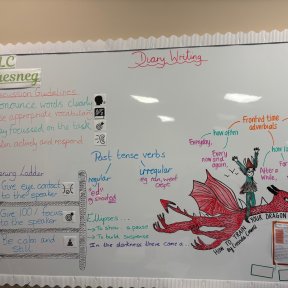
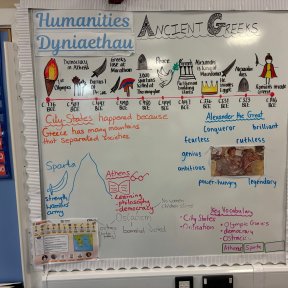
Working Walls:
Each of our classrooms have working walls. These are a specific selection of displayed curriculum content - pertinent to the lessons, which teachers and pupils use to scaffold, reinforce, and consolidate learning. Each working wall is a teaching tool that are added to throughout a unit of work and show clear expectations to support learning.
Knowledge Organisers:
Knowledge organisers are simple, child-friendly overviews of what pupils are learning in each topic. In school, teachers use them to introduce key vocabulary, facts and concepts, helping children make links and build their knowledge step by step in line with our Progression in Knowledge and Skills (PKC) and the Curriculum for Wales. At home, families can use knowledge organisers to talk about learning, practise key words, ask questions and revisit important ideas. This shared approach helps children develop confidence, deepen understanding and become increasingly independent learners.
You can find the Knowledge Organisers for each year group here.
Enrichment Examples:
To further support our curriculum, each year group also has enrichment activities such as school trips and workshops to further their understanding of the units we teach. This provides a variety of 'real-life' opportunities for pupils, enabling them to achieve a fuller understanding of the world around them through direct experience. Visits or workshops provide an effective stimulus at the start of a unit of work as well as enhancing and supporting the curriculum.
The trip overview can be found here.
Pumpdeg Profiad Penigamp can be found here.